
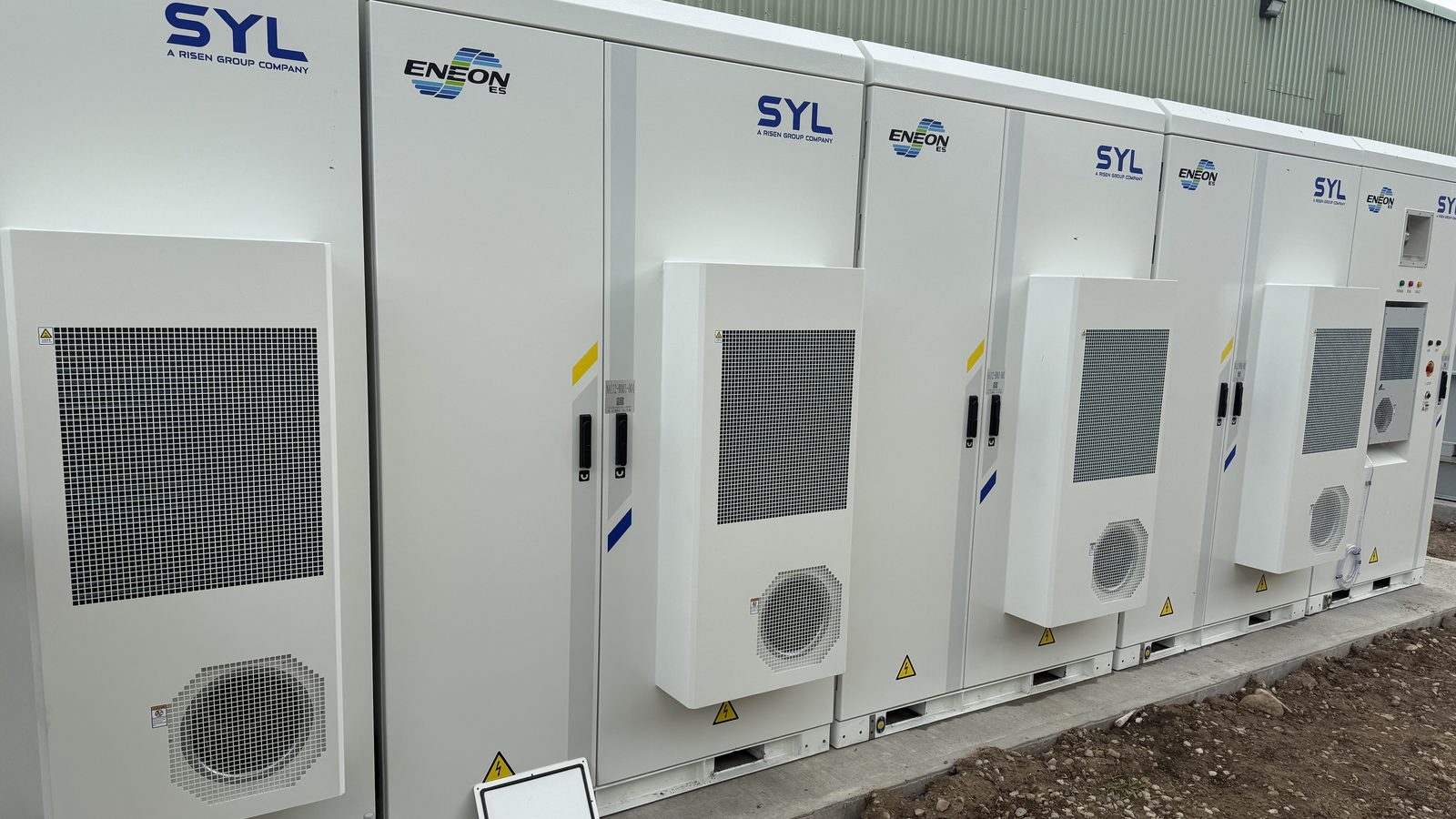
3.6 MW / 7.2 MWh, Woodstock
We were the EPC contractor for the peak-shaving battery at a Tier 1 battery manufacturer in Woodstock, ON, online July 2026 and able to offset up to 3.6 MW of grid demand during critical peaks.
Global Adjustment and the ICI program breakdown.
For Ontario's Class A customers, next year's Global Adjustment bill is decided by your demand during the province's top five peak periods. A battery that carries your facility through those periods cuts that charge at the source, worth roughly $300,000 to over $1,000,000 per year at recent GA levels.
For Ontario facilities with average monthly peak demand of 500 kW and up, whether already Class A or looking to opt in.
Free GA savings assessment: your Class A eligibility, peak profile and calculated savings range.

Avoided GA per MW, recent levels
$300-500k / year
Annual ICI opt-in window
June 1-15
Licensed electrical contractor
ECRA/ESA #7017432
Capacity auction, 2026-27 price
~$170k / MW-year
The Global Adjustment funds Ontario's generation contracts, refurbishments and conservation programs. It is often the largest single line on a commercial bill, up to 70% of total electricity cost for some industrial customers, and it is set to grow as infrastructure and nuclear refurbishment bills arrive.
How you pay Global Adjustment Fees depends on your usage class. Class A pays by peak demand factor: your facility's share of provincial consumption during the year's top five peak periods. Class B pays a rate on every kWh.
Each class has different opportunities. Class A can be smart about five specific peak periods. Class B can only consume less.
| Class B | Class A | |
|---|---|---|
| Pays GA on | Every kWh | Top-5-peak period share |
| Default for | Up to 5 MW, unless opted in | Above 5 MW |
| Opt-in at | n/a | 1-5 MW, any business |
| Opt-in 500-999 kW | n/a | Manufacturing, greenhouse |
| Battery leverage | Moderate (demand charges, arbitrage) | Very high (GA) |
500-999 kW opt-in requires a NAICS code starting 31-33 (manufacturing) or 1114 (greenhouse, nursery, floriculture). Eligibility re-qualifies every year; we confirm yours in the assessment.
Each year between May 1 and April 30, the IESO records provincial demand hour by hour. The five highest peak periods, almost always weekday afternoons during summer heat waves, become the measuring stick: your consumption during exactly those peak periods, divided by the province's, is your peak demand factor for the following billing year.
Reduce your electrical consumption during those five peak periods and you reduce your Global Adjustment charge for a full year. That is what the battery is for: it discharges through every predicted peak window while your production runs untouched.
The peaks cluster. Multiple top-five periods can land in a single afternoon or one brutal week in July, which is exactly why automated storage does not impact your operations.
| May 1 to Apr 30 | Base period: peaks are recorded |
| May 31 | Your utility delivers your peak demand factor |
| June 1 to 15 | Opt-in window: forms due to your utility |
| July 1 | New Class A billing takes effect |
| June to September | Peak season: the battery provides the most value. |
A battery must be interconnected and operating before summer peaks to reset next year's factor. Projects take months: a correct project timeline that aligns with the IESO program helps provide a predictable savings window.
Enter your facility's average monthly peak demand (it is on your bill, or your utility's portal). The calculation uses recent per-MW Class A values.
Estimates use $300-500 per kW-year of curtailed peak at recent GA levels and assume the battery reduces consumption below the threshold where global adjustment charges begin every peak period. The free assessment will confirm your savings with your metered numbers.
Estimated avoided Global Adjustment
$0
Range reflects recent per-MW Class A values. Can be combined with the IESO capacity auction (~$170k/MW-year at the latest clearing price) where it fits.
Peak calls come in bunches. Catching all five peaks with confidence means responding to nine or more alerts each summer. Manual curtailment pays for every false alarm in lost production, idle staff and restart costs.
A battery answers every alert for cents. Discharging through a window that turns out not to be a top-five peak period costs a battery cycle, not a shift. So the system responds to every plausible alert and drives the odds of missing a peak toward zero.
Production never stops. The facility keeps running at full output while the facility grid draw is reduced. There is no shift rescheduling or impacts to the facility, the battery system takes over automatically based on the predictive software.
Savings you can audit. The IESO publishes the final top-five peak periods and your utility issues your peak demand factor. You verify the result from your own bill, not from our reporting.
3.6 MW / 7.2 MWh, Woodstock
We were the EPC contractor for the peak-shaving battery at a Tier 1 battery manufacturer in Woodstock, ON, online July 2026 and able to offset up to 3.6 MW of grid demand during critical peaks.
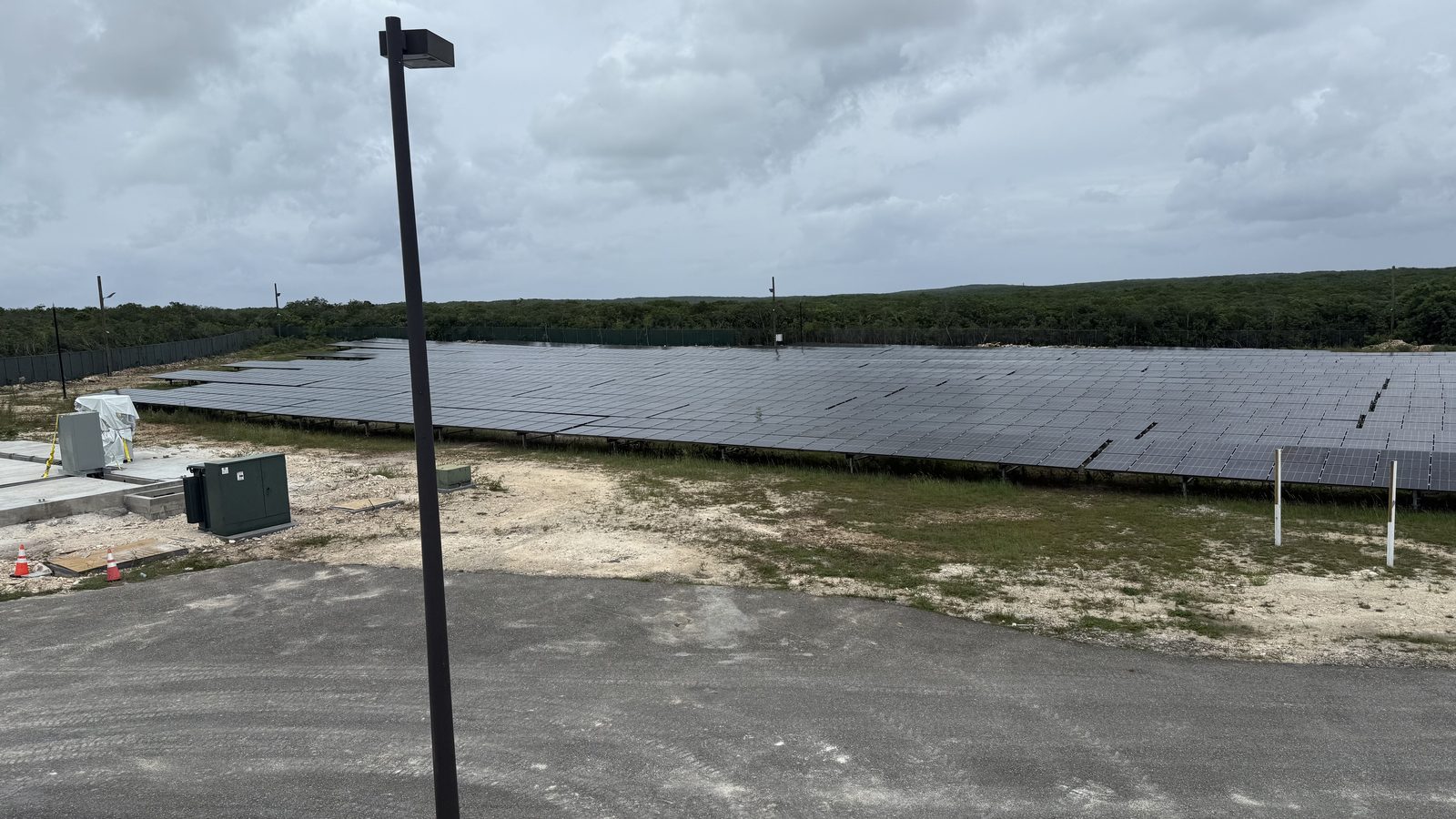
1 MW / 4 MWh battery, island microgrid
Interconnection wiring, battery and inverter installation support, and communications cabling and testing on the local utility's solar-plus-storage microgrid in the Turks and Caicos, plus support for Hitachi and the client through commissioning.
"Peak Power highly recommends EcoVolt Electric Inc. for battery energy storage, solar energy, electric vehicle charging, and other complex renewable energy and electrical construction projects."Scott McBrayne, Chief Operating Officer, Peak Power, on the Vuteq battery project
"EcoVolt planned ahead, raised issues early and took ownership of solutions, keeping the project on track."Justin Cunningham, Group Chief Executive Officer, Compass Solutions International
Excerpts from letters of recommendation. Full letters available on request.
For many facilities in the 500 kW to 2 MW range, our assessment will help you make the decision to own the project or finance it: at recent GA levels of $300,000 to $500,000 per year, with the federal tax credit of up to 30% and 100% first-year capital cost allowance, every dollar of savings after payback is yours.
For qualifying battery projects, EcoVolt can also finance, build, own and maintain the system on a shared-savings basis: it is paid for out of the Global Adjustment savings it creates over a 15-year term. You invest nothing and keep your share of the savings from day one.
Either way, you work directly with the contractor that builds these systems, from the ICI tiers written for 500 kW manufacturers and greenhouses up to multi-megawatt plants.
| Own it | $0 upfront | |
|---|---|---|
| Upfront investment | Project cost | $0 |
| Global Adjustment savings | All of it | Shared, 15 years |
| Federal tax credit (up to 30%) | Yours | Claimed by EcoVolt as owner |
| Maintenance | Yearly contract available | Included |
| End of term | Yours from day one | Buy at fair market value |
| Eligibility | Any project size | Owned building. |
Ownership priced in every assessment, and financing wherever your project qualifies, with conservative GA scenarios.

The fair question, answered honestly: the program has run since 2011, a full ministry review concluded in 2022 by making it more transparent rather than smaller, and the province's 2025 integrated energy plan left it intact. Industry credits it with 1,500-2,000 MW of peak reduction, roughly two large nuclear units Ontario Generation did not have to build.
No program is guaranteed forever. That is why we design every system to earn from multiple streams: Global Adjustment, the IESO capacity auction, demand charges and backup value. If one stream changes, the asset keeps working.
The dispatch system responds to every plausible peak alert, and false alarms cost a battery cycle instead of a production stop, so coverage is a numbers game the battery is built to win. The design assumption is responding to roughly nine or more alert windows per summer to catch five peaks.
During your free assessment we will determine your usage type and the programs that apply to you. Outside of the global adjustment program, the IESO's Peak Performance Program and demand-charge savings are the alternative path, and we will tell you honestly which applies.
Yes. The IESO explicitly allows Class A customers to also participate in the capacity auction, directly or through an aggregator. The auction cleared at roughly $170,000 per MW-year for the 2026-27 commitment period. One caveat: the IESO does not tell auction participants which periods are ICI peaks, so dispatch has to handle both signals. Our system design handles both signals and does not limit operations of the battery.
Systems are UL 9540 listed with UL 9540A thermal-runaway test data, sited to NFPA 855, and ESA inspected. Our outdoor containerized systems are inspected by the building department and fire marshal for insurance documentation as part of the project.
From third-party data, not our dashboard. The IESO publishes the final top-five peak periods and system totals each May, and your utility issues your peak demand factor by May 31. Your own bill shows the result.
Yes, for eligible projects, in a building you own. EcoVolt owns and maintains the system for a 15-year shared-savings term, funded by the Global Adjustment savings it produces, and at the end of the term you can buy it at fair market value.
Engineering, interconnection and construction typically run several months to a year depending on size and your utility's queue. To affect next year's factor, the system must be operating before summer peaks, so the planning window for any given summer closes early in the year.

Prefer to talk? (705) 984-7771